Tuesday, February 22, 2011

Chunky Hermes


The other night at dinner J. and I told our friends about the scantily clad man we had seen on Lincoln Road. "Hermes," I had said to J. and then ran to catch up with the man in the red bathing suit. I had wanted to to get a closer look at his helmet and shoes, which reminded me of the wing-bearing hat and sandals in which Hermes is always depicted. I had wanted to see him from the front. The Hermes on Lincoln Road goes to the gym and rides a bike. He had had to dismount because of the shopping and strolling crowd.

We poured more wine and went on talking about the man with the bike. 'You know about those birds who always follow an old flight path even though almost every thing below has changed, even though planes, towers block the way?' I asked. Our friends nodded yes. Lincoln Road used to be quiet. There had been few restaurants, almost no brand-name shops, no crowds. It was common to see a person undressed for the beach, whizzing by on a skate board or bike. 'The man in the helmet was like those birds,' I said. He had blundered into a crowd. The beach is just a few blocks away. Before Lincoln Road had become a shop-and-eat mall, where people wore street clothes, there hadn't been such a sharp distinction between beach and street. It was lovely then when in the long afternoon Lincoln Road was almost deserted.

'He's an exhibitionist,' J. said. He went there to be seen.

'His face was tense,' I said, and thought, Exhibitionists should at least smile as they preen. A close-mouthed smile would do. In the photo at the bottom he looks imperious, but mostly he looked tense, ill at ease, and angry.


I could have tried to speak to him. Photographer friends I admire speak to their subjects and quote them. They have a moral and ethical position: they share power, so to speak, and allow another's point of view. Timidity may have stopped me. Timidity and his speed. I'm a poet who's on Whitman's side when he writes: "I am afoot with my vision." I like to imagine, envision, eavesdrop, spy. Usually I empathize. About the man in red--brief red--already other interpretations occur to me. Isn't that what we do: interpret?

(From Wiki: Ancient Anglo-Saxon law punished eavesdroppers, who skulked in the eavesdrop of another's home, with a fine; the eavesdropper was also sometimes called the eavesdrop. Eavesdrop also means a small low visibility hole near the entrance to a building (generally under the eaves) which would allow the occupants to listen in on the conversation of people awaiting admission to the house. Typically this would allow the occupant to be prepared for unfriendly visitors.)

Monday, February 14, 2011

Rites of Friendship


Roland Barthes has a graceful, original view of friendship. In his 'autobiography' he writes about himself in the third person, which I believe allows him an insouciant distance and the appearance of objectivity:

Just as we decompose the odor of violets or the taste of tea, each so particular, so inimitable, so ineffable, into several elements whose subtle combination produces the entire identity of the substance, so he realized that the identity of each friend, which made that friend lovable, was based upon a delicately proportioned and henceforth absolutely original combination of tiny characteristics organized in fugitive scenes, from day to day. Thus each friend deployed in his presence the brilliant staging of his personality.

. . . he liked to abide by the minor rites of friendship to celebrate with a friend the release from a task, the solving of a problem: the celebration improves upon the event, adds to it an unnecessary addition, a perverse pleasure.

By "perverse" I believe he means "surprising" rather than "kinky." What were these "minor rites of friendship"? His must have included food and drink: he was French. What else: cigars? Do you celebrate rites of friendship? Tell me about them, please. As for me, I'm all for celebrating, with a friend or myself, "the release from a task, the solving of a problem." Turning the trick on work by following it with pleasure--light, graceful pleasure. When I think this way, work itself becomes less arduous, less threatening. I imagine Barthes across the table from a friend who "deployed in his presence the brilliant staging of his personality."

Wednesday, February 2, 2011

Out Until Dark


It was freedom to walk away from my desk--work and worries--and go out in the middle of the afternoon while there was still plenty of light. These trees, one on each side of the entrance of a building on Lenox, grow full in unobstructed light, fill the scrappy front yard, and shade the worn facade. The woman in a pink sari came home.


I went on to the beach and walked north at low tide. Yellow flags at the lifeguard stations signaled rough water, danger, rip tide; purple flags signaled more danger from men of war and jelly fish. I picked my way. The surf was cold.

Feet back in Crocs, I walked west and bought a loaf of bread, west again to the thrift shop, where I bought forks. By the time I got to Flamingo Park, the lights were on. Five thirty, school night, parents, mostly mothers out with their children, people in motion laying out dinner.


The lights shone brighter. I watched children play soccer. By the time I got home it was dark, new moon invisible.


Monday, January 24, 2011

Fashion Shoot Backside


In this Richard Avedon photo, we don't see backsides, not the elephants', not the model's. She's svelte, sylph-like. What was she thinking? Was she allowed to speak? These questions may sound trite to those who know more about fashion photography than I do--I don't know much. When I saw a fashion shoot on Ocean Drive I was shocked: the model was almost completely mute, though I heard her murmur a few words just before she and the crew changed location, crossing the street to the Versace house.


There, near the steps where the designer was murdered, the model relaxed a little, shifting her weight before the shoot continued. She was silent. The tag shows at the striped sweater's back neckline.


While the photographers conferred, she did not speak. Mid-day in hot Florida, dressed for fall in long sleeves, she waited, alone. Plump, scruffy, in short sleeves, clothes rumpled, the photographers worked to get the best shots.


She worked too, obeying, keeping her cool. I wondered about the final shots: would she look powerful and perfect? The goal is to sell a product. I'll take for free the backside tag, hair-shifting breeze, plump belly. Will I be open enough to let my subjects speak? Photographers whose work I admire often record their subjects' words. Others I also admire, shoot living subjects with such empathy that I don't miss the words. Empathy and also the shock of recognition: Arbus shows us herself in her subjects. Do you worry about such things? Do you let your subjects speak?

Monday, January 17, 2011

Playful South Beach


There are times when the passing scene is playful and language delightful: the two C's in Corn on the Cob, "Friendly John," "Bob's Barricades"--I didn't get a shot of those. Tell me what surprised and delighted you today.


Lawn jockey holding a lamp, cinder blocks, white impatiens, white curlicues: we humans are able and determined to create arrangements.


Seven small, post-like plaster lions stationed on this fence, two more life-size lions near the door.


South Point Park is sculpted, the carved/molded hill a backdrop for shadows in the late afternoon.


The lighthouse-lifeguard station appears through the planted 'wild' area.


Figures on the slant. I didn't tilt my camera. People gather here at sunset.


These three on the hill did not look up at the towering condo.


The Habana is miles from Cuba. Workers have filled the cracks in the facade so the crazed surface appears startling white. (Mostly I've seen crazed surfaces on glazed plates, miniature lines compared to these.) I hope they keep those bold colors. Buildings shift and settle on land that was once a mangrove swamp.


Wednesday, January 12, 2011

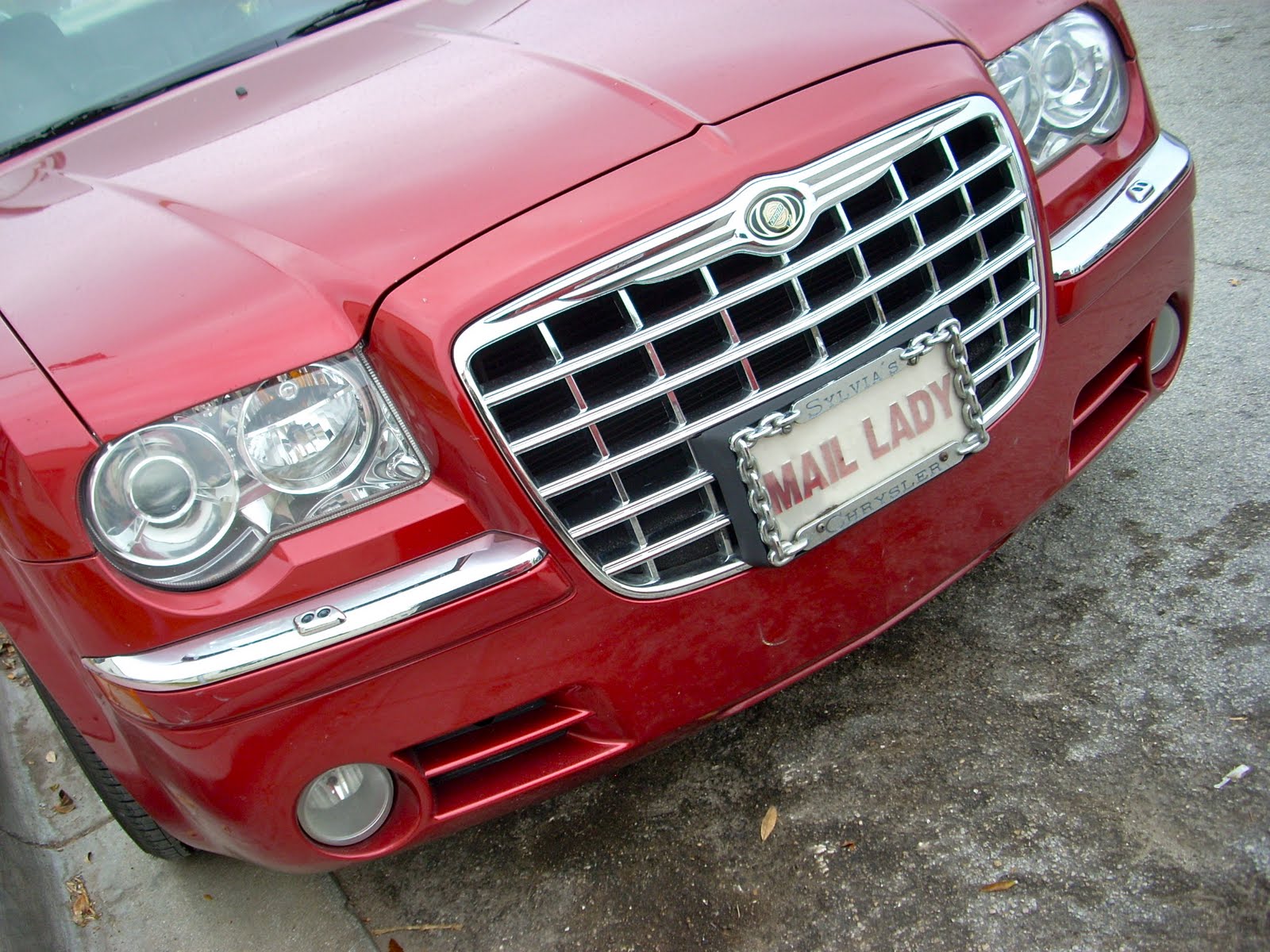
Mail Lady Chrystler


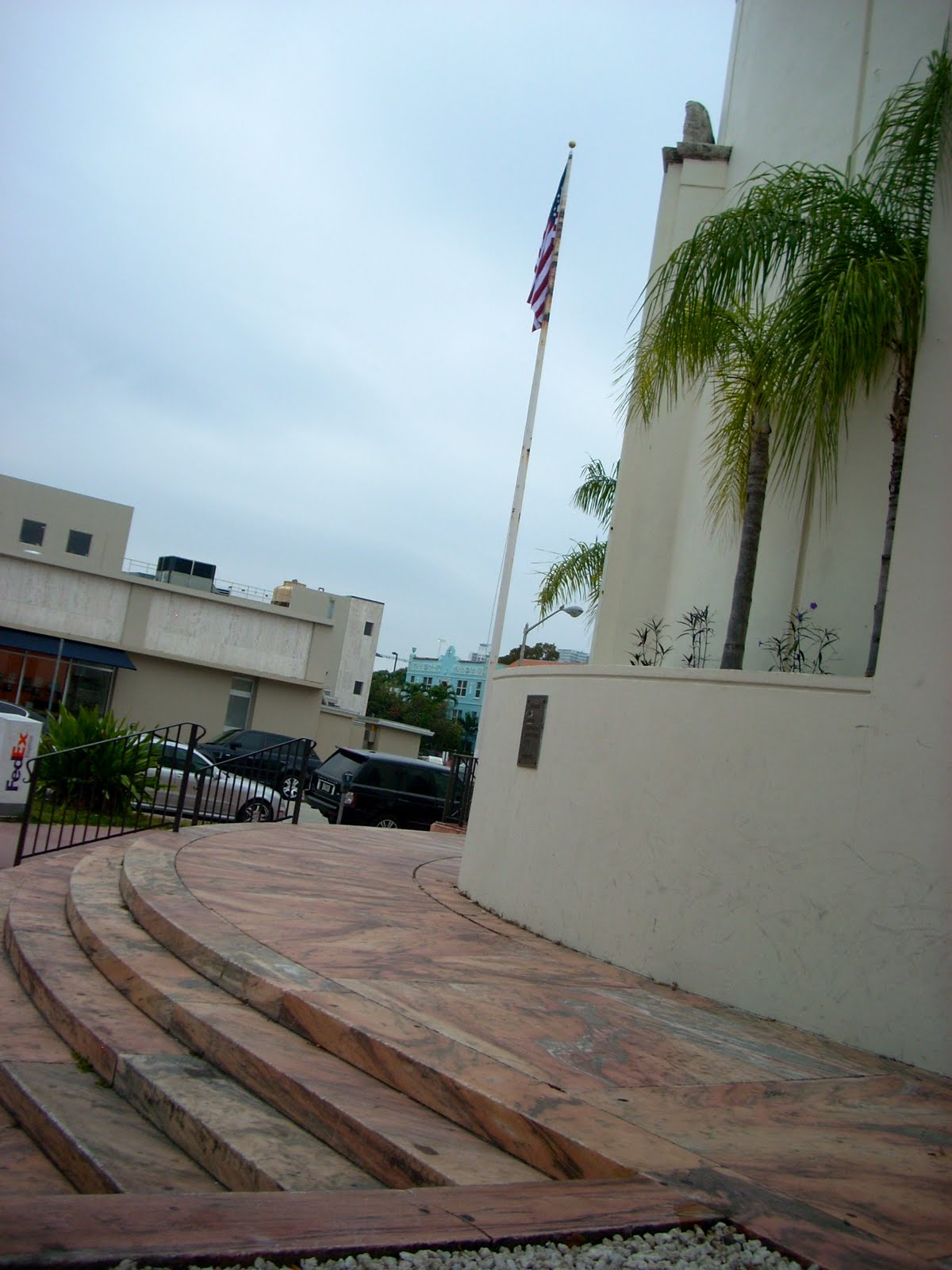
This morning in SoBe the "Mail Lady" car was parked in front of the 13th Street Post Office, which was built in 1937 during the Great Depression. Henry Morgenthau, Jr., the champion and key planner of Social Security was Secretary of the Treasury.


The U.S. MAIL sign on the dashboard signifies official business. I don't know the Mail Lady's official title. The sign may allow her free parking.


Morgenthau's name and Postmaster James Farley's are carved on a plaque at the front of the building, along with other names and the date, which I take pleasure in repeating--1937--and placing before our year: 2011. Styles change. It's a worn-out truism that appearances deceive. Yet we choose how to appear, how to present ourselves. The Mail Lady presents herself in a red Chrystler: "Mail Lady" in an auto drama starring the car and herself. She's made herself a character and given the character a name. (I don't know her other names.) What was she thinking, if she was thinking? Flaunt it? Look, I made it! Is that what she means? Tell me, what do you think? I was shocked, though I love red.


On the way home I saw this chalk drawing of a truck the rain will wash away.


Thursday, January 6, 2011

Relentless Ants, Drifting Clouds


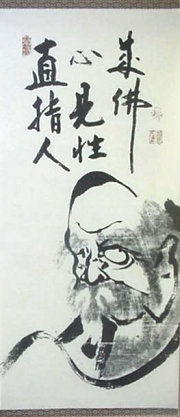
Hakuin (1685-1768)

This Zen master, I've recently learned, often painted the image of an ant circling a grindstone. Round and round the ant goes. Ants will relentlessly follow an ant track. Repeat, repeat. Relentless repetition: call it obsession; call it despair, call it slavery. Slave masters enforce unrelenting repeated motion. Why when the slave master is dead or no longer in power, do we repeat, repeat, exhausting ourselves? Even a wise person like Hakuin cannot give a pat answer. Instead he exhorts:

An ant goes round and round without rest
Like all beings in the six realms of existence,
Born here and dying there without release,
Now becoming a hungry ghost, then an animal.
If you are searching for freedom from this suffering
You must hear the sound of one hand.

(Not "one hand clapping," the way the line has been translated.)

I wonder whether Hakuin drank tea. I did this morning--some green. Not bad!

Yesterday I shot a picture of an empty decaying house in South Beach. The ants and termites are taking it down. Eating it, undermining it. Are you smiling with me? Are you ant-like today? Are you free? Are you both? I can't do it alone. Ants of the World, Unite. We'll wear away the world together. And unlike ants, watch the clouds drift. They're massing southward, cumulus; low, stratus. Mixed: there's even mackerel-mottled. I grew up, a noodle-eating city girl who seldom looked at the sky. Books and mud-pie pleasures. Years later, the window of my Boston room had a view to the sky. With J. I saw the sky over the Allagash--other skies too. The same sky here in South Beach seems endless--more endless, if there is such a thing--endlessissimo. Venus low and bright at 4: AM. My Crocs squeak on the tile floor. Dust blows in. The little metal table rusts. From the trash shoot on our floor, my lithe neighbor runs barefoot, bare-chested back to his apartment, empty handed.